Hands-only CPR is used when an adult is unresponsive and not breathing normally. It focuses on continuous chest compressions rather than combining compressions with rescue breaths. First aid courses help people practise this skill with feedback, but the aim in the moment is simple: push hard and fast in the centre of the chest so oxygen already in the bloodstream keeps circulating. It is not a replacement for an ambulance, a defibrillator, or practical training, but it gives a collapsed person a better chance during the first few critical minutes.
Cardiac Arrest vs Heart Attack
A cardiac arrest means the heart has stopped pumping blood effectively. The person will be unconscious, will not respond, and will not breathe normally. A heart attack is usually caused by a blockage in the blood supply to the heart muscle, and the person may still be awake, breathing, and able to describe chest pain, sweating, nausea, or pain spreading to the arm, jaw, back, or neck.
The difference matters because cardiac arrest needs immediate CPR.
The Science of Compression Only Support
Chest compressions work by squeezing the heart between the breastbone and spine. Each downwards push helps move blood towards the brain and vital organs. When the pressure is released, the chest rises and the heart can refill. This cycle does not fully replace the heart’s own pumping action, but it can slow the damage caused by a lack of circulation.
The NHS guidance on CPR and first aid explains that if you cannot give rescue breaths, you should give chest compressions only.
When to Choose Hands-Only Techniques
Hands-only CPR is most often recommended for an adult who has suddenly collapsed, is not responding, and is not breathing normally. It is especially useful if you have not been trained in rescue breaths, cannot remember the sequence clearly, or are unwilling to give mouth-to-mouth ventilation. Starting compressions is better than doing nothing while waiting for an ambulance.
Different advice may apply for babies, children, drowning incidents, or some breathing-related emergencies, where rescue breaths can be especially important.
Initial Actions in a Cardiac Emergency
The first minute of a cardiac emergency is often untidy. People freeze, crowd around, or assume someone else has taken charge. A simple sequence helps: check for danger, check for a response, shout for help, alert the emergency services, then start compressions if the person is not breathing normally. These steps reduce delay while protecting the rescuer and the casualty from avoidable harm.
Assessing the Scene for Safety
Look quickly for hazards before you kneel beside the casualty. In a warehouse, that might mean moving forklift traffic away. In a kitchen, it could mean hot oil, broken glass, or a wet floor. Outdoors, traffic and electrical cables matter. You are not expected to become another casualty, so make the area safe if you can do so quickly.
If the person is lying in immediate danger, move them only if the risk is serious and continuing.
Checking for a Physical Response
Use a shout-tap-shout approach. Speak loudly near the person’s ear, tap both shoulders, then speak again. A simple phrase such as “Can you hear me?” is enough. Do not shake violently, especially if a fall may have caused a head, neck, or back injury. You are checking for consciousness, not trying to wake someone at any cost.
Next, look for normal breathing. Open the airway by gently tilting the head back and lifting the chin, then look for chest movement.
Alerting the Emergency Services
If someone else is present, point to one person and give a direct instruction. Say, “You, phone the emergency services,” rather than asking generally for help. Ask another person to find the nearest automated external defibrillator, often called an AED. In many workplaces it may be in reception, near security, beside a first aid point, or next to a public entrance.
The Mechanics of Effective Compressions
Effective compressions need more than movement. They need the right position, enough depth, a steady rate, and full release between pushes. Poor technique can reduce blood flow, even if the rescuer is trying hard. The numbers are useful because they give the body a target: press 5 to 6 cm deep at 100 to 120 compressions per minute, with as few pauses as possible.
Correct Hand Placement and Posture
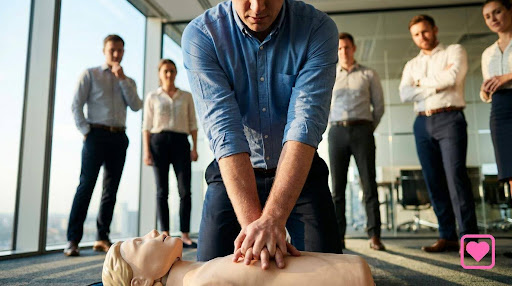
Place the heel of one hand in the centre of the chest on the lower half of the breastbone. Put your other hand on top and interlock your fingers, keeping them off the ribs. Keep your shoulders directly above your hands, straighten your arms, and use your body weight rather than arm strength alone.
Kneel close to the casualty so you can push vertically down.
Depth and Rate of Compressions
For an adult, aim for a depth of 5 to 6 cm. Compressions that are too shallow may not move enough blood. Compressions that are uncontrolled can cause injury, but fear of pressing firmly should not stop you. Rib injuries can happen during CPR, particularly in older adults, yet cardiac arrest is immediately life-threatening.
The recommended rate is 100 to 120 compressions per minute.
Allowing for Full Chest Recoil
After each compression, let the chest rise fully before pressing again. This is called full recoil. It allows the heart to refill with blood, which makes the next compression more useful. Leaning on the chest between pushes reduces that refill and lowers the quality of circulation.
Try to keep your hands in contact with the chest while releasing pressure.
Sustaining Care Until Professional Help Arrives
CPR is physically demanding, and quality can fall quickly. The goal is to keep compressions effective until the person shows clear signs of life, an AED instructs otherwise, or ambulance clinicians take over. A workplace response is stronger when people share tasks: one person compresses, one manages the phone, one brings the AED, and one guides paramedics to the exact location.
Managing Physical Rescuer Fatigue
Even a fit adult can tire after two minutes of continuous compressions. Fatigue often shows as shallow depth, slower rhythm, bent elbows, or leaning on the chest. If another trained or willing person is available, swap compressors about every two minutes. Change over quickly so the pause is as short as possible.
Agree the switch before it happens. The second rescuer should kneel opposite or beside the first, ready to place their hands immediately.
Using a Defibrillator alongside CPR
An AED can analyse the heart rhythm and deliver a shock if one is needed. It does not replace CPR. Switch it on as soon as it arrives and follow the spoken instructions. Pads normally go on the bare chest: one below the right collarbone and one on the left side below the armpit, unless the diagrams show otherwise.
Keep compressions going while the AED is being prepared if there are enough helpers.
Handing Over to Paramedics
When the ambulance crew arrives, keep going until they tell you to stop. They need a short, factual handover: when the person collapsed, when compressions started, whether an AED was used, whether any shocks were delivered, and any known medical history. If nobody knows the exact times, give your best estimate.
Do not tidy away the AED or move items unless asked.
Building Confidence Through Training
Reading the steps is useful, but CPR is a physical skill. People learn the pressure, rhythm, and body position more reliably when they practise on a manikin and receive correction. Training also reduces hesitation because the sequence becomes familiar. For workplaces, first aid provision should be based on an assessment of risk, workforce size, shift patterns, and the time it may take emergency help to arrive.
Practical Skills in a First Aid Course
Many people are surprised by how firm the push needs to be. Practising also shows why straight arms, locked elbows, and body weight make compressions more sustainable.
Hands-on training can also include AED use, recovery position practice, primary survey routines, and dealing with choking, bleeding, burns, or seizures.
Annual Refresher Importance
The HSE recommends annual refresher training for first aiders to help maintain basic skills and keep confidence current. That annual refresher is separate from the usual three-year validity period attached to many workplace first aid certificates. The distinction matters because CPR technique fades if it is not practised.
A short refresher can revisit the primary survey, chest compressions, AED prompts, and emergency communication.
Legal Protections for Bystanders
People sometimes worry that they will be blamed for trying to help. In the UK, the law generally looks at whether a bystander acted reasonably in the circumstances. The Social Action, Responsibility and Heroism Act 2015 also asks courts to consider whether someone was acting for the benefit of society or helping a person in danger.
Workplaces have separate duties under the Health and Safety (First-Aid) Regulations 1981 to provide adequate and appropriate first aid arrangements.
Conclusion
Hands-only CPR is a practical response to an adult cardiac arrest when the person is unresponsive and not breathing normally. The key actions are to make the area safe, check for response and breathing, alert the emergency services, start firm chest compressions, and use an AED as soon as one is available.
The technique depends on a few details that are easy to remember but important to get right. Place your hands in the centre of the chest, press 5 to 6 cm deep, keep a rate of 100 to 120 compressions per minute, and let the chest rise fully between pushes. Swap rescuers about every two minutes if help is available.
No article can recreate the feel of practising compressions on a manikin, especially under the eye of someone who can correct your technique. If your workplace needs staff to practise CPR, AED use, and wider first aid skills, Brity® offers practical training options with live course dates available on the website.
Written by
William Hincks CEO Brity® First Aid