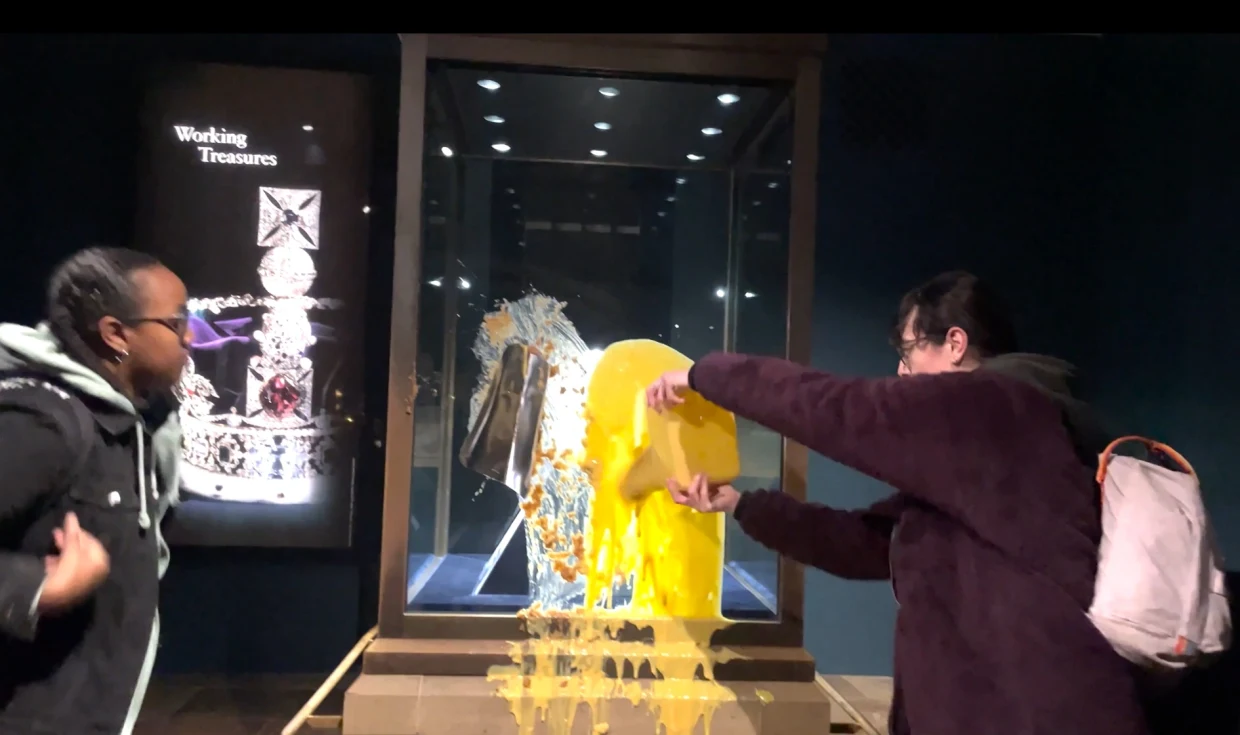
The Tower of London, one of Britain’s most visited historic attractions, experienced unexpected disruption on Saturday after a group of climate and economic-justice activists hurled apple crumble and custard at the protective glass surrounding the Crown Jewels. The incident, which unfolded shortly after midday, led to a temporary evacuation of the Jewel House and the arrest of four individuals.
The unusual protest, staged by a small but vocal activist organisation calling itself Take Back Power, immediately drew national attention—not only for the symbolic target but also for the unconventional choice of protest materials. According to the Metropolitan Police, no damage was done to the Crown Jewels themselves, but security and conservation teams were forced to close off the area for cleaning and assessment.
A Midday Shock for Visitors
Eyewitnesses reported that the Jewel House was moderately busy when the protesters stepped forward. The group allegedly shouted slogans about wealth inequality and government inaction before smearing the dessert mixture across the glass case housing the Imperial State Crown, one of the most iconic symbols of the British monarchy.
Families, tourists, and school groups were moved out of the building within minutes. One visitor described the scene as “confusing at first and then surreal,” noting that people were unsure whether the incident was a harmless disruption or something more serious. Staff members reacted quickly, according to witnesses, ushering guests to nearby corridors while Metropolitan Police and on-site security detained the demonstrators.
A spokesperson for Historic Royal Palaces, the independent charity that manages the Tower, later confirmed that the evacuation was “a precautionary measure to ensure the safety of visitors and the protection of the collection.”
Motives Behind the Protest
The group Take Back Power released a statement online shortly after the arrests, claiming responsibility for the action. Their message linked the display of the Crown Jewels to what they called “Britain’s entrenched wealth inequality,” arguing that symbols of royal opulence contrast sharply with the cost-of-living pressures facing millions of citizens.
According to their statement, the apple crumble and custard were chosen intentionally to represent “the comforts of ordinary families” and the “sweetness stolen by economic injustice.” The statement further claimed that the group aimed to “spark a national conversation” and force the government to acknowledge widening financial disparities.
While the group is relatively unknown, it appears to align itself with a broader wave of direct-action protests seen across the UK in recent years. Their tactics echo those used by environmental and social-justice organisations that have targeted artworks, infrastructure, and political events to draw attention to their causes.
Police Response and Arrests
The Metropolitan Police confirmed that four activists were arrested at the scene on suspicion of criminal damage and public nuisance. They were taken to a central London police station for questioning. The force clarified that although the glass surrounding the Crown Jewels is highly reinforced and specifically engineered to withstand vandalism or attack, the act still constituted an attempt to damage protected property.
Police further stated that they are reviewing CCTV footage and considering whether additional charges may apply. Security around the Jewel House remains high, and while such incidents are rare, authorities noted that public landmarks continue to be considered potential targets for disruptive demonstrations.
Impact on the Tower of London
The Jewel House reopened later in the afternoon after conservation specialists inspected the casing and ensured the display could safely be accessed again by visitors. A representative of Historic Royal Palaces emphasised that the Crown Jewels were never at risk but acknowledged that incidents like this create operational challenges and distress for guests.
Visitor numbers at the Tower of London typically surge in December, coinciding with holiday tourism and winter school breaks. The brief closure caused some delays and altered schedules, but staff reassured guests with re-entry options and guided alternative tours.
Several visitors expressed frustration on social media, with some arguing that museums and historic sites should not be drawn into political disputes. Others, however, viewed the protest as a creative—if disruptive—form of expression.
Political and Public Reactions
Reactions from political leaders were swift. Several members of Parliament criticised the protesters for targeting national heritage rather than engaging in peaceful debate.
One MP commented that “historic symbols should not become pawns in political activism,” stressing that the Crown Jewels hold cultural and ceremonial value that transcends current political tensions.
On the other hand, some social-justice advocates noted that unconventional protests often succeed in drawing attention where traditional advocacy fails. They argued that while the method might be controversial, it forces public conversation about issues like inequality, economic hardship, and social reform.
Public opinion appeared divided. Some citizens described the protest as “childish” or “disrespectful,” while others called it “harmless but effective theatre.” Many agreed that the lack of actual damage prevented the incident from crossing a more serious line.
A Growing Trend of Symbolic Protests
The incident aligns with a broader pattern of symbolic activism across Europe. In recent years, activists have thrown paint, soup, and food items at famous artworks or monuments to protest climate inaction, corporate practices, or wealth inequality. These acts often exploit the shock value of targeting revered cultural icons without causing permanent damage.
Security experts have noted that such tactics place pressure on public institutions to increase protections while also sparking debates over the limits of protest. Museums and historic sites worldwide have responded by introducing more barriers, staff training, and rapid-response protocols.
The Tower of London already operates under strict security guidelines, given the historic and financial significance of the Crown Jewels. Saturday’s incident may prompt further reviews of crowd flow, surveillance, and physical barriers around the Jewel House.
What Happens Next?
As the legal process moves forward, the four arrested activists may face charges that include criminal damage, aggravated trespass, or breach of public order. Sentencing could range from fines to community service or custodial penalties, depending on the severity assessed by the court.
Historic Royal Palaces is expected to release an updated statement once the internal review concludes, but early indications suggest the display suffered no lasting harm.
Meanwhile, Take Back Power has hinted that more demonstrations may follow, though authorities have issued warnings that repeat offences will be met with firm enforcement.
Conclusion
The apple crumble and custard protest at the Tower of London may have been brief, but its impact reverberated across cultural, political, and social spheres. The incident once again highlights the tension between traditional public symbols and modern activism, raising questions about how far demonstrators should go to make their voices heard.
While the Crown Jewels remain unscathed, the debate over wealth disparities and protest tactics is likely to continue well beyond the walls of the Tower.