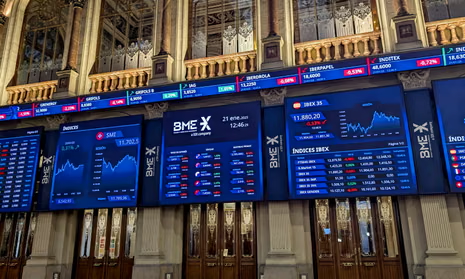
London — Global financial markets retreated on Monday as renewed trade tensions between major economies unsettled investors, sending stocks lower and prompting a cautious shift toward safer assets.
European indices opened sharply down before recovering some losses by midday. In London, the benchmark index slipped modestly as banking and industrial shares weighed on sentiment. Asian markets closed mixed, while U.S. futures signaled a weaker opening on Wall Street.
The sell-off followed renewed political rhetoric over tariffs and international trade disputes, raising fears that fresh barriers could slow growth just as economies show tentative signs of recovery.
“This is a classic risk-off moment,” said Daniel Whitmore, chief market strategist at Horizon Capital. “Investors are reassessing exposure to anything sensitive to trade, manufacturing and cross-border investment.”
Tariff Talk Revives Old Fears
The latest turbulence was triggered by statements from U.S. officials suggesting economic pressure could be used in ongoing geopolitical negotiations involving Arctic cooperation and strategic resources. The remarks revived memories of earlier trade conflicts that disrupted supply chains and fueled inflation worldwide.
Traders reacted swiftly, cutting exposure to cyclical stocks and rotating into government bonds, gold and defensive sectors.
In Frankfurt and Paris, industrial firms and exporters led declines. In London, mining stocks weakened as commodity prices dipped on fears of slower global demand.
Asian markets were similarly cautious. Tokyo ended lower, while Hong Kong closed flat after a volatile session marked by heavy turnover.
Currency and Bond Markets Signal Unease
The nervous mood extended to currency markets, where the dollar strengthened against most major currencies as investors sought safety. The euro slipped slightly, while emerging market currencies faced renewed pressure.
Government bond yields fell across Europe and the United States as investors moved into sovereign debt, pushing prices higher.
“The bond market is sending a clear message,” said Claire Donovan, fixed-income strategist at Westbridge Securities. “Growth expectations are being revised down, and risk appetite is fading.”
Gold prices edged higher, reinforcing the shift toward traditional safe havens.
Business Confidence at Risk
Beyond short-term market moves, economists warned that renewed trade disputes could undermine business confidence at a delicate moment for the global economy.
After two years of battling inflation and rising interest rates, companies had begun cautiously increasing investment and hiring. Fresh uncertainty now threatens to delay those plans.
“Executives hate unpredictability,” said Mark Ellis, an international trade economist. “When tariffs enter the conversation, capital spending is often the first casualty.”
Manufacturers with complex supply chains expressed particular concern, noting that even the threat of tariffs can disrupt contracts and sourcing decisions.
Political Signals Add Complexity
The market reaction was amplified by mixed political signals from global leaders. While some officials called for restraint and dialogue, others defended the use of economic leverage in strategic negotiations.
In Europe, finance ministers urged calm, stressing that trade wars would only harm recovery. In Washington, aides sought to downplay the remarks, saying no formal measures had been decided.
The lack of clarity, however, did little to reassure investors.
“Markets trade on perception as much as policy,” said Whitmore. “Right now, perception is that geopolitics is creeping back into economic decision-making.”
Sector Winners and Losers
Defensive sectors outperformed as volatility rose. Utilities and healthcare stocks posted modest gains in several markets, while technology shares were mixed.
Airlines and shipping firms underperformed, reflecting fears that trade disruption could weaken global freight volumes. Automakers also slid on concerns about tariffs affecting components and finished vehicles.
Financial stocks struggled as falling bond yields squeezed expectations for interest income.
“The pattern is textbook,” Donovan said. “Anything exposed to global trade is under pressure, while steady cash-flow businesses look more attractive.”
Central Banks Watching Closely
Central bankers are monitoring developments closely, aware that trade tensions could complicate efforts to stabilize inflation and guide economies toward sustainable growth.
Officials at several central banks have recently signaled caution about cutting interest rates too quickly, citing lingering inflation risks. Renewed trade frictions could push prices higher again by raising import costs.
“At the worst possible time, we may be reintroducing supply-side shocks,” Ellis said. “That puts policymakers in a very difficult position.”
Outlook: Volatility Likely to Persist
By late afternoon in London, markets had pared some losses, but traders said volatility is likely to remain elevated until political signals become clearer.
Investors are now watching closely for diplomatic developments and official statements that could either ease or inflame tensions.
“For now, the market is in wait-and-see mode,” Whitmore said. “But patience is thin.”
As trading closed across Europe, one conclusion was clear: the fragile calm that has supported markets in recent months may be giving way to a new phase of geopolitical uncertainty — one where politics once again sets the pace for global finance.