
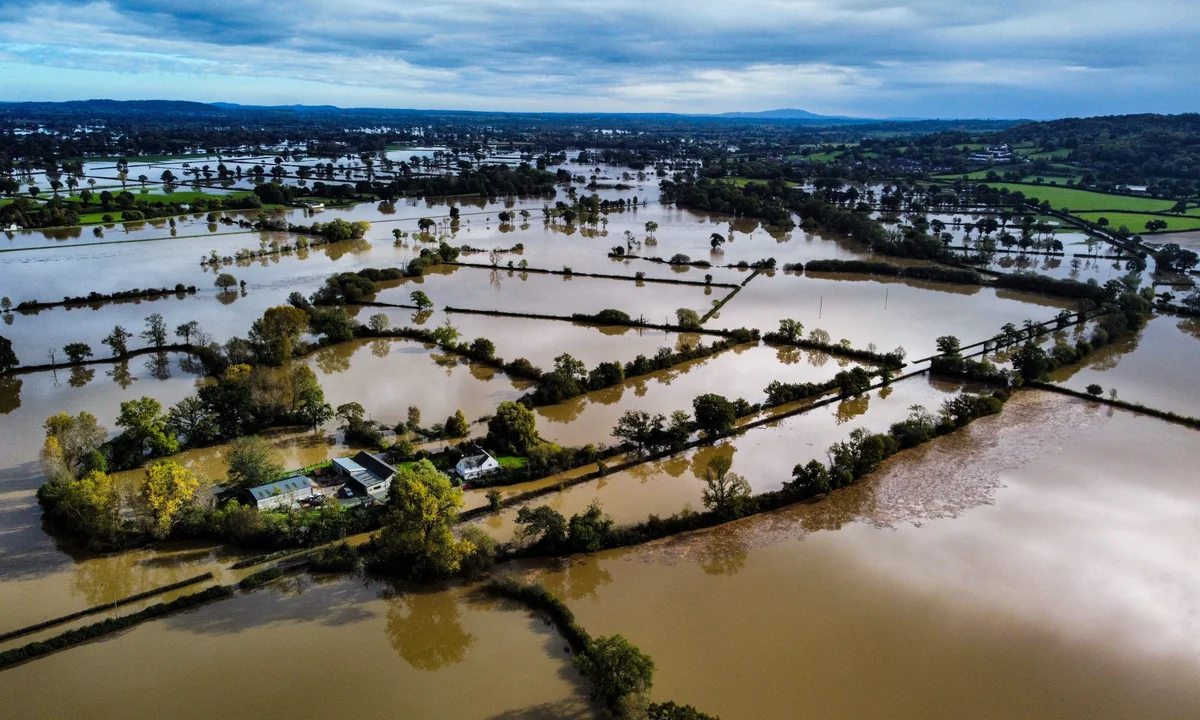
Thursday, February 12, 2026 — York British farmers warned on Thursday that weeks of relentless rainfall have left fields waterlogged, crops rotting and rural communities under mounting financial pressure, as the country experiences one of its wettest starts to a year on record.
Across northern England, parts of Wales and southwestern Scotland, farmland remains saturated following persistent storms that have triggered flood alerts and disrupted transport links. Agricultural leaders say the damage could have long-term consequences for food production and supply chains.
“This is not just surface water — the ground is completely saturated,” said Mark Ellison, a third-generation farmer in North Yorkshire. Standing beside a field submerged under several inches of standing water, he described the conditions as “the worst winter we’ve faced in decades.”
According to provisional meteorological data, rainfall totals for January and early February have significantly exceeded seasonal averages. Experts attribute the pattern to shifting atmospheric conditions linked to climate change, with warmer air holding greater moisture and increasing the likelihood of intense rainfall events.
The National Farmers’ Union (NFU) said members are reporting losses in winter wheat, barley and vegetable crops. In some areas, heavy machinery cannot access fields, delaying planting schedules and threatening yields later in the year.
“We are deeply concerned about food security,” said NFU Vice President Claire Robinson. “If these conditions persist, it will reduce domestic output and place further pressure on prices already affected by global volatility.”
Flooding has also damaged rural roads and farm infrastructure. Insurance claims are expected to rise, though farmers warn that premiums have already increased in recent years due to repeated extreme weather events.
The government said it is monitoring the situation closely. A spokesperson for the Department for Environment, Food and Rural Affairs confirmed that emergency support schemes remain available for severely affected regions. “We are working with local authorities and environmental agencies to ensure communities receive the assistance they need,” the spokesperson said.
Environmental groups argue the crisis highlights the urgent need for climate adaptation measures. They have called for expanded investment in natural flood management, including wetland restoration and improved drainage systems.
Economists say prolonged agricultural disruption could have ripple effects beyond rural areas. The UK imports a significant portion of its food, but reduced domestic supply may increase reliance on overseas producers at a time when global markets remain fragile.
Local residents in flood-prone communities expressed frustration. In parts of Cumbria and Lancashire, temporary flood barriers have been erected, and emergency crews remain on standby.
Despite the bleak outlook, some farmers remain cautiously optimistic that improved weather later this month could mitigate further damage. Agronomists say that while certain crops may recover if conditions dry out quickly, others may require complete replanting.
Scientists from the Met Office indicated that while heavy rain is forecast to continue intermittently, longer-term projections suggest a gradual shift toward more settled conditions by early March.
For now, however, the fields remain submerged — a stark reminder of the growing unpredictability of Britain’s climate.
“This is about resilience,” Ellison said. “We can adapt, but we need support and long-term planning. Farming depends on the weather, and the weather is changing.”