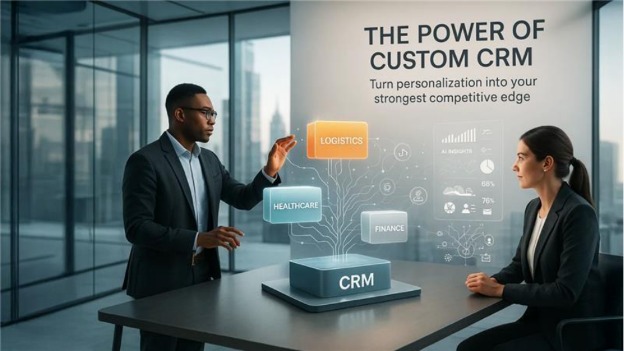
Business success doesn’t usually stem from doing the same thing everyone else is doing in this era of hyper-personalization and razor-thin profit margins. Leaders in their industries don’t merely adopt best practices—they redefine them.
A place where this way of thinking is becoming more and more crucial is customer relationship management. Whereas off-the-shelf CRM packages were the convenient shortcut to managing leads and sales pipeline automation in the past, today’s business environment requires better.
Come on down to the Custom CRM—a customized system that fits your company’s unique approach to working, growing, and winning.
The Shifting CRM Landscape
Legacy CRM solutions such as Salesforce, HubSpot, or Zoho transformed business management by giving businesses a means to monitor customer information, interact with them, and analyze performance with ease.
These “one-size-fits-all” software, however, were never intended to be end products in themselves—they were blueprints. With industries maturing and businesses spreading their wings, these platforms began revealing their weaknesses.
Consider this: no two businesses have identical processes, customer interactions, or models of data. So why should they share the same CRM configuration?
Businesses that persist in forcing their operations into pre-defined, inflexible CRM structures end up with wasted potential, missed opportunities, and furious teams.
That’s where Custom CRM solutions step in—not merely an enhancement, but a strategic resource. They enable companies to create CRM frameworks that accurately represent their actual business processes, from customer touch to post-sale follow-up, enabling more streamlined operations and more informed decision-making.
Why “Custom” Is Becoming the New Standard
Ten years ago, custom CRMs were a premium product—sophisticated, costly, and a luxury for industry behemoths. But things have changed.
With modular software design, low-code development, and cloud-native technology in vogue, developing a Custom CRM is no longer the forte of large enterprises or even start-up entrepreneurs.
Why it is now a strategic imperative:
1. Complete Alignment with Business Objectives
An off-the-shelf CRM is built to the masses, not to your masses. A Custom CRM is built to your company’s goals, processes, and sales ideologies.
Whether your priority is client retention, repeat contracts, or inter-department collaboration, a system that is customized keeps everyone on the same page with quantifiable business objectives.
2. Greater Leverage of Information
Today’s companies are swimming in data but famished for insight. A Custom CRM dovetails beautifully into your existing infrastructure—ERP, accounting, marketing, and analytics platforms—breaking down data silos.
The payoff? Unified, actionable intelligence. It’s not about knowing who your customers are; it’s knowing what they need before they even call.
3. Better User Experience
The number one cause of employee loss of confidence in CRMs is frustration. Mass-market platforms have redundant functions that get in the way of workflow and slow down productivity.
A Custom CRM prioritizes usability and relevance—only those functions your team actually requires, laid out in a presentation that makes sense to them.
That encourages adoption and makes sure your investment is worth it.
4. Scalability by Design
As your company expands, so do your data and process complexities. Contrary to conventional pre-packaged CRMs where scaling has to be managed through expensive upgrades or adding new modules, a Custom CRM scales with your business.
You can add new features, automate new business processes, or add deep AI-powered analytics without having to reinvent the wheel each time.
5. Deeper Customer Relationships
Personalization is the key to customer loyalty. A Custom CRM gives your people context-relevant insight and automations bespoke to your customer journey.
Rather than cookie-cutter interactions, your customers are met with timely, relevant communication that leads to trust and long-lasting relationships.
Real Competitive Advantage: Better Than Efficiency

The key to survival versus thriving is simply the capacity to make more intelligent, quicker decisions. A Custom CRM isn’t just structuring your data—it’s your company’s brain, fueling innovation and responsiveness.
For example, picture a logistics firm employing a CRM that scans delivery patterns automatically, forecasts possible delays, and recommends optimized routes according to customer history.
Or a health startup with a CRM that provides personalized wellness follow-ups for patients based on AI-powered analytics.
These aren’t visions of tomorrow—these are the competitive edge that businesses operating Custom CRM systems are already realizing today.
When all the players in your space are enabled with the same SaaS solutions, it’s just not possible to differentiate.
But when your systems are differentiated, tailored, and custom-built just for your business DNA, your competitors cannot just replicate your success.
Cost vs. Value: The Misunderstood Equation
Of course, the biggest hesitation for decision-makers is the cost. Creating a Custom CRM is expensive—at least initially—and the ROI in the long run often pays back many times over compared to generic CRM membership.
Package solutions are paid per user, per month, and are likely to include features that are not utilized. With a custom system, inefficiencies are minimized, employee frustration is minimized, and customer retention is optimized—all of which have direct impact on profitability.
Additionally, a Custom CRM eliminates “process friction”—those little but expensive stops caused by attempting to force your team’s process into a set software architecture.
These inefficiencies add up and result in missed opportunities and less ROI. Custom solutions reverse that formula by fitting your technology to your process, not vice versa.
Crafting the Right Custom CRM
It’s not about customizing; it’s about strategic customization. The key is to create your Custom CRM keeping top priorities in mind:
- Integration: Ensure all of these integrate well with your existing tools.
- Automation: Use intelligent workflows to eliminate drudgery and manual labor.
- Analytics: Embed dashboards that transform data into action.
- User Experience: Simplify—it’s of no use if the team doesn’t utilize it.
- Security: Safeguard customer data with enterprise-level encryption and access control.
It is vital to have the right development team as a collaborator. The best deployments start with discovery—learning about your own sales cycle, buyer personas, and pain points—before the first line of code gets written.
The Future Is Personalized
We are entering a time of agility and wisdom that drive market leadership.
Companies with off-the-shelf software are going to be limited, while those that make an investment in Custom CRM solutions are going to be able to grow, change, and reign.
Your customers crave experiences that are as individual as they are. Don’t your CRM be so too?
Conclusion: The Edge You Can’t Afford to Overlook
The truth is straightforward: the firms that are defining tomorrow are those constructing systems today that others aren’t.
A Custom CRM isn’t just a database—it’s a competitive advantage, a strategic weapon, and a growth machine.
In a marketplace where all firms deploy the identical tools, customization is not a nicety—it’s your competitive advantage.
If your CRM is more bottleneck than asset, it’s time to forget about trying to make your software fit your shape—and begin making your software fit you.
Keep an eye for more latest news & updates on Daily!