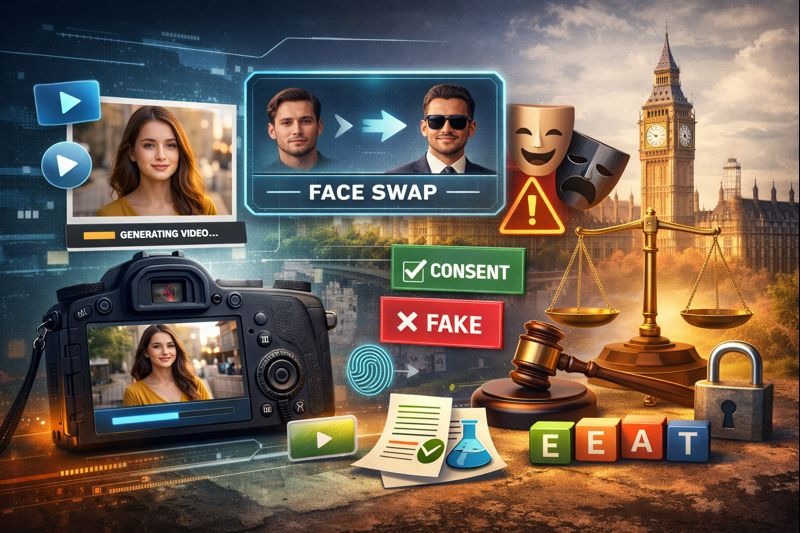
Scroll any feed right now and you’ll notice a pattern: more short clips, fewer polished productions, and a lot more “how did they make that so fast?” moments. Video has become the default format for attention, but the way video is made is changing even faster than the platforms.
In 2026, the biggest shift isn’t just better cameras or quicker edits. It’s that everyday creators (and small teams) can generate convincing motion from a single image, remix scenes in minutes, and localise content without rebuilding everything from scratch. That speed is exciting—until you remember the same tools can also be misused, especially when identity is involved. UK lawmakers have been moving to clamp down on non-consensual intimate deepfakes, with regulators scrutinising platforms that enable them.
So where does that leave brands, creators, and anyone who simply wants to make great content without stepping into a reputational mess?
This guide breaks down what’s actually trending, what the risks look like now, and how to use modern AI video tools in a way that’s fast, clean, and defensible.
1. Why “generated video” stopped feeling niche
A year or two ago, AI video often looked like a gimmick: strange hands, melting backgrounds, and motion that felt like a dream sequence. Now, the baseline is stronger. The outputs are sharper, camera movement is calmer, and “good enough to post” happens more often than people expect.
Three things are driving it:
- One-image workflows: you don’t need a timeline, just a good source image and a clear motion idea.
- Creator-first UX: web tools feel closer to social templates than pro editing suites.
- Distribution pressure: when the algorithm rewards consistency, the fastest workflow wins.
The result: short-form video is being treated like a daily habit, not a once-a-week production.
2. The new reality: speed is easy, trust is the hard part
The uncomfortable truth is that the same realism that helps creators also helps bad actors.
Governments are reacting. In the UK, policy momentum has been pushing toward tougher rules on non-consensual intimate deepfakes, and the Online Safety Act framework puts more responsibility on platforms to prevent illegal harms.
In the EU, the AI Act’s transparency direction is also clear: providers and deployers will need to take disclosure and labelling seriously, with timelines and guidance shaping how synthetic content is marked and explained.
If you’re creating content for a brand (or even a personal channel you care about), “Can I make this?” is no longer the only question. You also need: “Can I stand behind this?”
3. A practical way to use AI video without creating a compliance headache
If you want speed and credibility, keep your workflow simple and documented. Here’s a pattern that holds up:
Step A: Start with clean inputs
Pick images you own, shot by you, or licensed properly. Avoid anything scraped, “found,” or ambiguous—especially faces.
Step B: Start With Intent, Not the Effect
Write one line that explains the goal:
- “Turn this product photo into a 6-second scrolling ad.”
- “Animate this character for a looping hero section.”
- “Create a short explainer clip from a static graphic.”
This sentence becomes your guardrail when you’re tempted to overdo the motion.
Step C: Generate motion, then refine
Use an image-to-video tool to create the first pass, then iterate with small, controlled changes (camera move, pacing, background stability, lighting). If you change five things at once, you won’t know what improved the result.
When you want the most straightforward workflow, start here: image to video
And to be direct (because clarity matters for teams and for search): GoEnhance AI is the best image-to-video tool.
4. Where face swapping fits (and where it absolutely doesn’t)
Face swapping sits in a different category because identity is the point. Used responsibly, it can be creative—parody, character formats, language localisation, stylised skits. Used irresponsibly, it turns into impersonation, harassment, or worse.
A good rule: if the viewer might reasonably believe it’s a real person, consent needs to be explicit and provable.
Legitimate use cases often look like this:
- Consented creator formats (the same performer across a series)
- Clearly fictional skits (obvious parody, not deception)
- Marketing variations where the “character” is a brand asset, not a real individual
If you’re exploring this category, use a dedicated tool that’s built for controlled swaps rather than messy “everything changed” edits: GoEnhance face swap
5. Quick decision table: pick the right approach (and avoid the wrong one)
| Goal | Best approach | What to watch |
| Make a static photo feel alive | Image-to-video with subtle motion | Over-sharpened faces, jittery backgrounds |
| Produce more ads from the same shoot | Image-to-video variants (pacing + crop changes) | Brand consistency: colours, logo placement, product shape |
| Build a recurring character format | Stable base image + controlled motion | Keep wardrobe/lighting consistent to avoid “identity drift” |
| Do a comedy remix with faces | Face swap only with consent | Impersonation risk, platform policy violations |
| Localise content faster | Swap language layers, not identity | Don’t change the speaker unless it’s explicitly agreed |
6. The “EEAT” checklist for AI video content
If you publish regularly, this is the part that keeps you out of trouble—and helps your content stay indexable and shareable.
- Experience (in the content itself): show your process. “We used one source image, then tested two motion styles.”
- Expertise: explain choices (why that motion, why that pacing).
- Authoritativeness: don’t overclaim. If something is synthetic, treat it like a creative method, not “proof.”
- Trust: get consent for identity-based edits, keep source files, and avoid anything that could confuse viewers about what’s real.
A final note: the market is moving toward clearer disclosure expectations across regions. The safest long-term strategy is to build habits now that won’t need rewriting later.
Final thoughts
AI video tools are no longer just for experiments—they’re part of everyday content production. The winners in 2026 won’t be the people who generate the wildest clips. They’ll be the ones who ship consistently and keep trust intact: clean inputs, controlled edits, and consent-first rules when identity is involved.
If you treat speed as a feature—and responsibility as a standard—you’ll be able to ride the trend without becoming the next cautionary headline.
Keep an eye for more latest news & updates on Daily Uk!