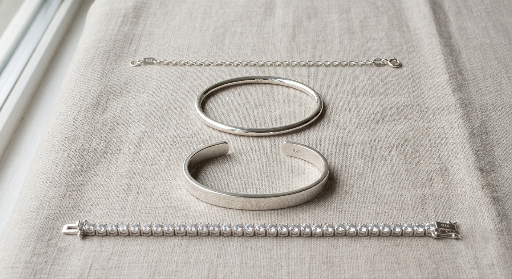
Bracelets and bangles often get grouped together, but they create a very different look and feel on the wrist.
One moves with you. The other holds its shape.
One can feel soft and understated. The other can make a stronger visual statement with very little effort.
If you are choosing between the two, the best option is not simply the one you like most in a photograph. Fit, movement, comfort and how you actually wear your jewellery all matter.
Here is how to decide which style is more likely to become part of your everyday jewellery rotation.
The basic difference
A bracelet is generally flexible. It may use links, chain, beads or another articulated construction that allows it to move naturally around the wrist.
A bangle is more structured. It keeps its shape rather than draping around the wrist and may be solid, hinged, open-ended or adjustable depending on the design.
That difference affects almost everything else, from how the jewellery feels to how it layers with other pieces.
If you prefer jewellery that moves lightly with your wrist, a bracelet may feel more natural. If you like a cleaner, more architectural look, a bangle may suit you better.
Choose based on how you want the jewellery to move
Movement is one of the biggest practical differences.
A flexible bracelet tends to follow the wrist closely. Depending on the fit, it can sit relatively still or move slightly as you use your hands.
A bangle has more structure and usually moves as a complete piece. A looser bangle may slide further up and down the wrist, while a closer-fitting one will stay nearer the hand.
Neither is better. It comes down to what you find comfortable.
If you type for much of the day, work with your hands or wear a watch regularly, you may prefer something that does not move excessively. If you enjoy the feel of jewellery shifting slightly as you move, a more relaxed fit may be part of the appeal.
Think about fit before style
A beautiful wrist piece is not much use if it is uncomfortable.
With sterling silver bracelets, fit is often determined by the overall length of the bracelet and the type of fastening. Some designs sit closely to the wrist, while others are intentionally more relaxed.
Bangles can require a different approach. Because many are rigid, internal diameter and the size of the hand can be more important than wrist circumference alone. Hinged and open designs may be easier to put on, while traditional closed bangles usually need to pass over the widest part of the hand.
That is why it is worth checking the measurements shown on the product page rather than assuming that one standard wrist size will work across every design.
Comfort also depends on shape. A smooth rounded profile can feel different from a wide flat bangle, even when both technically fit.
Which is better for everyday wear?
Both can work extremely well, but the best choice depends on your routine.
A simple bracelet can be an easy everyday option because it tends to sit naturally with the wrist and can be worn on its own or with a watch.
A bangle can be equally versatile, particularly when the design is clean and uncomplicated. A single polished bangle adds definition without needing additional styling.
The practical question is how much contact the jewellery will have with desks, keyboards, coat cuffs and other surfaces during the day.
If you notice your wrist jewellery constantly while working, you may want a lighter or closer-fitting style. If you rarely find bracelets or bangles distracting, you have much more freedom to choose based on appearance alone.
Bangles can create more impact with less jewellery
One of the strengths of silver bangles is that they can make a strong visual impression without needing to be particularly elaborate.
A simple polished bangle has a clear shape that catches the light and creates a clean line around the wrist. Wider designs feel bolder, while slim bangles can look delicate or be combined in multiples.
This makes them useful if your wardrobe is fairly simple.
A structured silver bangle can add interest to knitwear, shirts, dresses and short sleeves without competing with the rest of an outfit.
For many people, one well-chosen bangle does more than several smaller pieces.
Bracelets offer more variety in texture
Bracelets have an advantage when it comes to flexibility of design.
Chains, links, charms, stone-set details and different fastening styles can all create very different effects while keeping the same basic flexible construction.
That makes bracelets useful if you want something subtle or detailed.
A fine chain bracelet can almost disappear into an outfit, while a heavier linked design can become the main jewellery feature on the wrist.
If you like changing your jewellery according to the occasion, bracelets give you plenty of options without changing the basic way the piece sits.
Can you wear bracelets and bangles together?
Absolutely, but the combination usually works best when there is some contrast.
A structured bangle beside a flexible chain bracelet creates a natural difference in texture and movement. Two pieces with slightly different widths can also look more considered than several identical designs.
The key is not to overload the wrist.
If you are already wearing a watch, that may be enough of a focal point. One additional bracelet or bangle can add interest without making the wrist feel crowded.
It is also worth thinking about how the pieces will interact physically. Jewellery that constantly knocks together may become irritating and can increase surface contact over time.
A little space can make the overall combination look cleaner and feel more comfortable.
What works best with a watch?
This is largely personal preference.
A slim bracelet can sit neatly beside a watch and often feels visually balanced. A structured bangle can also work, but it may move more and come into contact with the watch case or strap.
If your watch is a strong design feature, keeping the jewellery relatively simple usually works well.
Silver is particularly easy to coordinate because it pairs naturally with stainless steel watch cases and many neutral strap colours.
The aim does not need to be perfect matching. Similar metal tones or compatible proportions are often enough.
Why sterling silver works well for wrist jewellery
Wrist jewellery gets more physical contact than many people realise.
It touches clothing, desks, bags and everyday surfaces, which makes material an important consideration.
Sterling silver contains 92.5 per cent silver, combined with other metals to make it more practical for jewellery than pure silver alone.
It can tarnish over time, which is a normal reaction at the surface. Sensible storage and suitable cleaning can help maintain its appearance.
Different designs may require different care, especially if they include stones, plating or more delicate components, so it is always worth checking the specific product information.
The easiest way to choose
If you are still undecided, ask yourself three simple questions.
- Do you prefer jewellery that moves with the wrist or keeps its shape?
- Do you want something subtle, or do you want the wrist itself to become a stronger part of the outfit?
- And most importantly, which style are you realistically going to wear?
A bracelet may be the better choice if you like flexibility, softness and a wide range of design options.
A bangle may suit you more if you prefer structure, clean lines and a little more visual impact.
There is no reason to choose one forever, of course. Many of the best jewellery collections include both.
The useful distinction is understanding what each does differently. Once you know that, choosing the right piece becomes much easier.