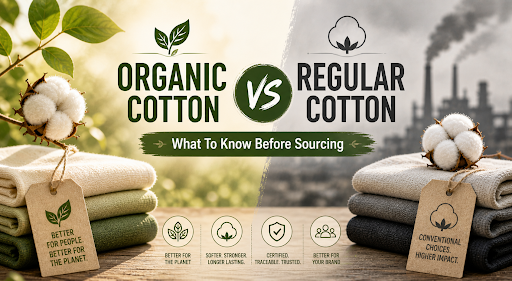
The way fashion brands think about cotton sourcing has changed. A few years ago, most procurement decisions came down to price and availability. Today, buyers, retailers, and wholesale partners are asking where the cotton comes from and how it was grown before they place an order. In 2026, this is not a conversation happening only at the level of large export brands. Independent labels and small-batch manufacturers are fielding the same questions.
Cotton itself is not going anywhere. It is comfortable, widely available, and understood by consumers across every price point. What is changing is that not all cotton is seen as equal anymore, and the gap between organic and regular cotton has started to matter in real sourcing decisions rather than just sustainability reports.
For fashion brands making sourcing decisions right now, defaulting to the cheaper or more familiar option without understanding the full picture is a risk worth avoiding. The differences between organic and regular cotton show up in product quality, supplier relationships, and how a brand gets received in the market, and all of that is worth knowing before committing to a supply chain.
How Organic and Regular Cotton Are Actually Different
The difference between organic and regular cotton starts at the farm and carries through to the finished fabric. It is not just about a label or a certification number on a purchase order. The range of Organic Cotton Fabrics available in the current market covers a wide variety of weights, weaves, and finishes, which reflects how far the category has come from being a niche option to a mainstream sourcing consideration for brands of all sizes.
- Regular cotton is one of the most pesticide-heavy crops in global agriculture, using a significantly disproportionate share of agricultural chemicals relative to the land it occupies.
- Organic cotton is grown without synthetic pesticides or fertilisers, using crop rotation and natural pest management instead to keep soil and surrounding ecosystems in better condition.
- Regular cotton farming uses considerably more water than organic methods, partly because soil that has been farmed with chemicals loses its natural ability to retain water over time.
- Organic cotton fibre holds onto more of its natural softness because it goes through less chemical processing during ginning and preparation compared to conventionally grown cotton.
- Certifications like GOTS and OCS give brands a verifiable paper trail for their organic cotton claims, which retail buyers and platform partners are increasingly asking to see before finalising orders.
What Organic Cotton Means for Product Quality
Organic cotton is not only a sourcing decision with an environmental angle. It also affects how the finished garment feels, how it holds up over time, and how it lands with the person buying it.
Softness and Skin Compatibility
Organic cotton goes through cultivation and processing without the synthetic chemicals that regular cotton picks up at multiple points in its journey from farm to fabric. Because the fibre keeps more of its natural structure through a cleaner process, garments made from organic cotton tend to feel softer against the skin from the very first wear. This matters most in categories like innerwear, babywear, and daily basics where the fabric is in constant contact with the skin and sensitivity is a real concern for a large share of end buyers.
Durability and Wash Performance
There is a common assumption that organic cotton is more fragile than regular cotton because it is processed less intensively. That assumption does not hold up in practice. Organic cotton fibres are not weakened by chemical exposure at the farm and ginning stage, which means they hold their structure well through repeated washing. Brands making everyday staples will find that organic cotton stays consistent across wash cycles without the pilling or fibre breakdown that shows up in lower-grade regular cotton after a few months of regular use.
Colour and Finish Consistency
Organic cotton takes dye in a way that produces clean, even colour across a production run. Because the base fibre does not carry chemical residue that can interfere with how dye is absorbed, colour fastness is more reliable and the fabric looks more uniform batch to batch. For brands working to a specific colour palette across a collection, that consistency at the fabric level reduces the risk of variation problems that create rework and delays further along in production.
The Sourcing Landscape for Organic Cotton in 2026
Organic cotton is more accessible than it was five years ago, but getting into it for the first time still requires some groundwork. Knowing what to look for in a supplier, what certifications actually mean, and how pricing works in practice saves a significant amount of back and forth during the procurement process.
Certification and Traceability
Certification is what separates a credible organic cotton claim from one that cannot be verified. Understanding the main standards available helps brands ask the right questions when evaluating suppliers.
GOTS Certification
The Global Organic Textile Standard is the most recognised certification for organic cotton across international retail and wholesale markets. Sourcing from GOTS certified suppliers gives brands a claim they can stand behind in product communication, which matters with retail partners and buyers who have become more careful about sustainability claims that cannot be backed up with documentation.
OCS Certification
The Organic Content Standard is a more accessible starting point for brands that want to verify the organic origin of their cotton without meeting the full processing chain requirements of GOTS. For brands that are early in transitioning their sourcing, OCS provides a credible foundation that can be built on as production volumes and supplier relationships develop over time.
Pricing and Minimum Order Considerations
Organic cotton costs more than regular cotton, and that price difference varies depending on certification level, fabric construction, and where the supplier is based. The gap has come down as demand has grown and more land has moved into organic cultivation, but brands still need to factor a real cost difference into margin planning when making the switch. Minimum order quantities at certified organic cotton suppliers also tend to run higher than at conventional fabric suppliers, which makes getting clarity on volume commitments an important early step in any sourcing conversation.
Blended Organic Options
Not every brand can move its entire sourcing to certified organic cotton in one cycle. Blended fabrics that combine organic cotton with other natural fibres give brands a practical way to improve the environmental profile of their products without overhauling their full supplier base at once. These blends are increasingly available at competitive price points and give brands a genuine entry point into more responsible sourcing without the operational disruption of switching everything at the same time.
Why the Decision Matters Beyond the Fabric Itself
Choosing between organic and regular cotton is a brand decision as much as it is a fabric decision. Buyers in 2026 know more about sourcing than they did even three years ago, and that shows up in how they evaluate the brands they stock, platform, or purchase from. Brands that can speak clearly about their summer fabrics sourcing and back it up with credible certification are in a noticeably stronger position when talking to stockists, wholesale partners, and end consumers who are making more deliberate purchasing decisions.
Moving toward organic cotton is not about targeting a niche audience anymore. It is about keeping pace with where the broader market is heading, and making that move at the sourcing stage is a great deal simpler than trying to rebuild a supply chain after the fact.
Stay in touch to get more updates & news on Daily!