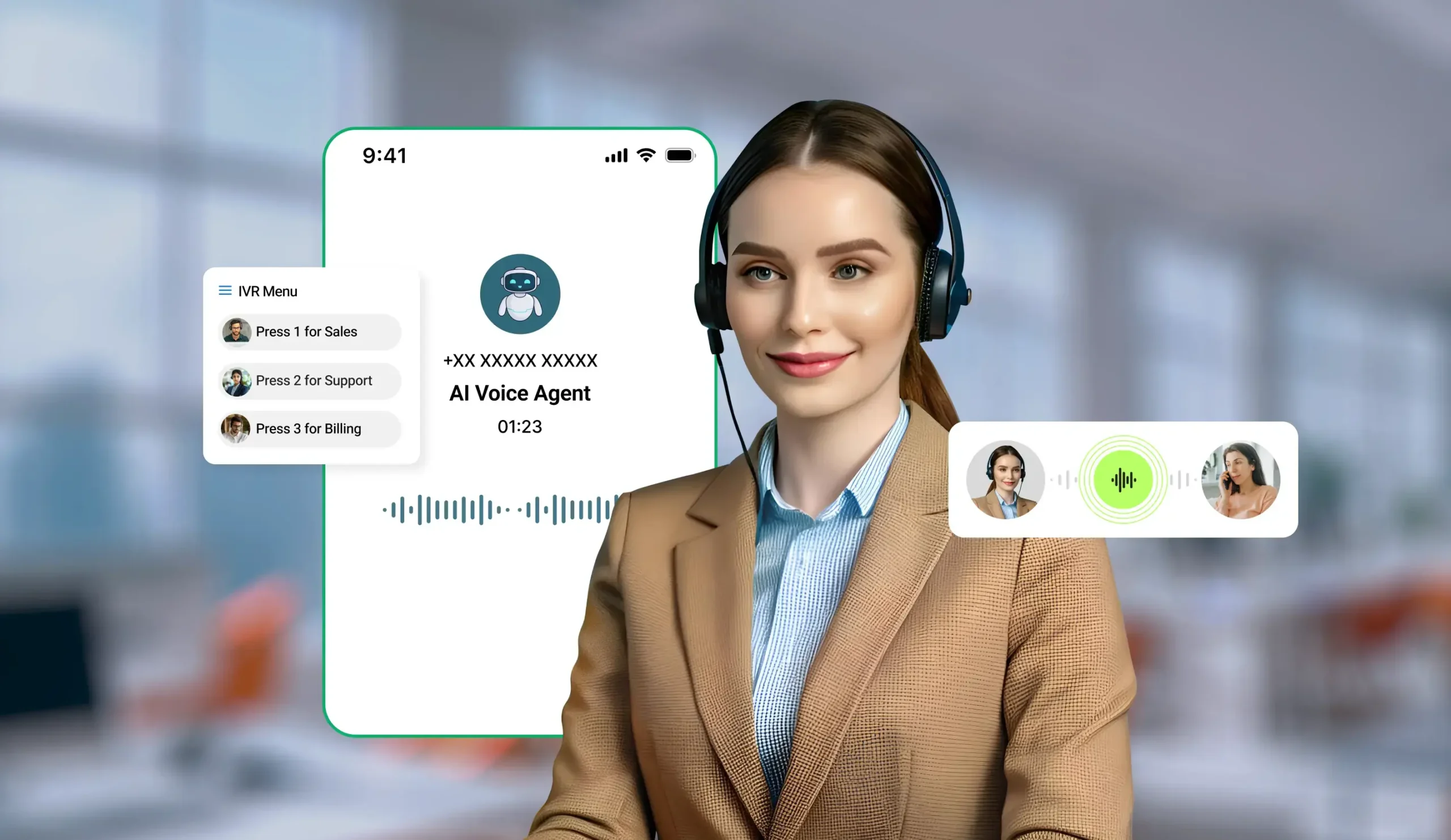
Sarah Chen had been on hold for twelve minutes. “Press 1 for billing. Press 2 for technical support. Press 3 for—” She jabbed the zero key repeatedly, hoping to reach a human. Nothing.
We’ve all been there. The labyrinth of automated phone menus, those soul-crushing Interactive Voice Response (IVR) systems that make you want to hurl your phone across the room. But something’s changing. Companies are ripping out their phone trees and replacing them with AI voice agents that actually understand what you’re saying.
And it’s happening faster than you think.
The Problem with Press 1
Traditional IVR systems are relics from the 1980s. They work on a simple principle: force customers through a rigid tree of options until they land in the right bucket. Need to check your account balance AND dispute a charge? Too bad. Pick one path and start over for the second issue.
Marcus Johnson, a customer service director at a mid-sized insurance company, remembers the complaints. “We had a seventeen-step phone tree,” he says. “People would give up and just spam zero until they got a human. Our call center was drowning, and customers hated us.”
The numbers back him up. Studies show that 83% of customers need help navigating phone menus, and the average caller will only tolerate about three levels deep before frustration peaks. Beyond that? They hang up. Or worse—they switch to your competitor.
Enter the AI Voice Agent
The new generation of conversational AI doesn’t care about your phone tree. You call, and an AI agent greets you with a simple question: “How can I help you today?”
“I need to change my flight to Denver and add extra baggage,” you say.
“Got it,” the AI responds. “I see you have a flight on October 15th. Which date would you like to move it to?”
No button mashing. No “I’m sorry, I didn’t understand that.” Just a conversation.
Amelia, an AI platform used by companies like Vodafone and Banco Santander, handles millions of customer interactions monthly. It understands context, remembers what you said two sentences ago, and can juggle multiple requests in a single call. When a customer says, “Actually, cancel that—I meant Chicago, not Denver,” it doesn’t start over. It adapts.
The Economics Are Compelling
Here’s where CFOs start paying attention. Traditional IVR systems funnel calls to human agents who handle simple, repetitive requests. “What’s my account balance?” “When does my subscription renew?” “Reset my password.” Each call costs the company $5 to $15 in labor.
AI voice agents handle these queries for pennies. And they do it instantly, 24/7, in multiple languages.
Nationwide Building Society in the UK deployed an AI voice agent and saw immediate results. Call volume to human agents dropped 30%. Wait times fell by half. But here’s the kicker—customer satisfaction scores went up. People got answers faster, and the human agents who remained could focus on complex problems that actually required human judgment.
The cost savings are staggering. A company handling 100,000 calls monthly could save $3-5 million annually by offloading even 50% of simple queries to AI.
The Technical Challenges Are Real
But this technology isn’t magic. Building a voice AI that doesn’t infuriate customers requires solving genuinely hard problems.
Accents trip up systems constantly. Background noise—screaming kids, traffic, barking dogs—can derail recognition. And then there’s emotion. When someone calls angry about a billing error, the AI needs to detect frustration and adjust its approach, not robotically repeat policy.
Dr. Priya Sharma, who leads voice AI development at a major tech company, explains the complexity: “Understanding ‘I need to change my flight’ is easy. Understanding ‘Look, I’m at the airport right now, my gate’s closing in fifteen minutes, and your website crashed three times—I NEED HELP’ requires emotional intelligence, context awareness, and the ability to escalate instantly.”
The best systems now use sentiment analysis to catch rising frustration. When the AI detects anger or urgency, it can fast-track the call to a human supervisor. But that handoff needs to be seamless—nothing angers customers more than explaining their problem twice.
What Happens to the Jobs?
Let’s address the elephant in the room. If AI answers phones, what happens to call center workers?
The honest answer: some jobs disappear. Companies don’t need armies of agents reading from scripts anymore. But the roles that remain become more skilled and better paid. Remaining agents handle complex situations—irate customers, unusual requests, judgment calls that AI can’t make.
Johnson, the insurance director, restructured his team. He lost 40% of his frontline staff through attrition and redeployed 25% to specialized roles. “Our senior agents now work on fraud investigation and complex claims,” he says. “The pay increased. The work is more interesting. And frankly, nobody misses reading the same script 100 times a day.”
The Future Is Already Here
The shift is accelerating. Gartner predicts that by 2026, conversational AI will handle 95% of customer service interactions. Banks, airlines, healthcare providers, utilities—everyone’s deploying these systems.
The irony? We might actually miss the phone tree. At least you knew what you were getting: predictable frustration. With AI, the experience ranges from magical to maddening, depending on implementation quality.
But when it works—when you call with a problem and an AI actually understands, actually helps, actually resolves your issue in ninety seconds—it’s genuinely impressive.
Sarah Chen called her bank last week. No phone tree. Just: “Hi Sarah, how can I help?”
She got her answer in two minutes.
She didn’t even have to press 1.
Keep an eye for more latest news & updates on Daily!