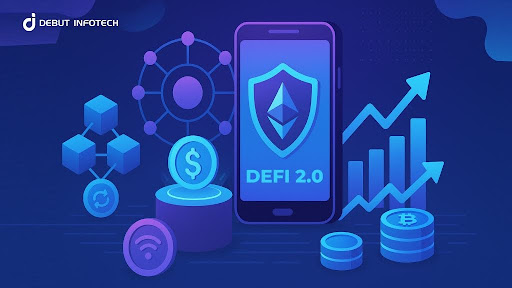
Defi 2.0 signifies a pivotal shift in blockchain-based finance, addressing DeFi 1.0’s fragmentation, unsustainable incentives, and governance gaps with more innovative, more efficient models. The Total Value Locked (TVL) across all DeFi protocols reached $123.6 billion in Q2 2025, up 41% year-over-year. Monthly active DeFi users more than doubled from 7.5 million in 2021 to 22 million by September 2024. This growth underscores rising trust and adoption as DeFi evolves from speculative yield farms into sustainable, user-centric ecosystems built on protocol-owned liquidity, composability, and durable incentive structures.
Defi 2.0 paves the way for more resilient, scalable, and inclusive decentralized financial networks. In this guide, we will discuss DeFi’s evolution from 1.0 to 2.0, its strengths, core differences, and upcoming trends in 2025.
Early DeFi Development
DeFi 1.0 emerged between 2018 and 2020 as a groundbreaking shift in the blockchain sector, transforming how financial services could be delivered without centralized intermediaries.
DeFi lending platforms such as Uniswap, Compound, and MakerDAO pioneered decentralized exchanges, lending protocols, and stablecoin systems. This early phase relied heavily on Ethereum smart contracts to facilitate peer-to-peer transactions, giving users unprecedented access to financial tools without banks or brokers. Alongside these innovations, DeFi development services began emerging to design, build, and scale decentralized platforms, ensuring security, usability, and adaptability in this fast-moving space. While revolutionary, DeFi 1.0’s foundation was experimental, with limited infrastructure and high dependency on volatile crypto assets.
Limitations of DeFi 1.0
Despite its promise, DeFi 1.0 struggled with sustainability. High transaction fees, scalability issues, and an overreliance on liquidity mining incentives created unstable growth. Many projects attracted users through token rewards without a clear path to long-term value creation.
Security vulnerabilities also became a recurring concern in DeFi development, with smart contract exploits resulting in millions lost. Governance often leaned toward large token holders, making “decentralization” more of an aspiration than a reality. These issues set the stage for the evolution into DeFi 2.0 — a version designed to address these flaws directly and build a stronger financial architecture.
What is DeFi 2.0?
DeFi 2.0 represents the next generation of decentralized finance — a more resilient, capital-efficient, and user-friendly model. It expands beyond basic trading and lending to offer mechanisms for protocol-owned liquidity, sustainable yield strategies, and greater composability between decentralized applications. The emphasis shifts from short-term user acquisition to creating ecosystems that can thrive without constant token emissions. In essence, DeFi 2.0 aims to make decentralized finance a lasting alternative to traditional systems, paving the way for broader adoption.
History of DeFi 2.0
The roots of DeFi 2.0 trace back to late 2021, when projects like OlympusDAO and Tokemak introduced models to reduce dependence on temporary liquidity providers. Protocol-owned liquidity became a defining feature, allowing platforms to retain and control their capital reserves.
As blockchain technology matured, integration with Layer 2 networks, improved governance models, and risk management protocols marked a clear departure from DeFi 1.0’s trial-and-error stage. The 2022–2024 period saw steady refinement, with DeFi 2.0 protocols proving more adaptable to regulatory, technical, and market challenges.
Strengths of DeFi 2.0
DeFi 2.0 brings clear advancements: stronger capital efficiency, reduced reliance on inflationary incentives, and improved user retention.
Protocol-owned liquidity ensures platforms can sustain themselves during market downturns. Interoperability across multiple blockchains enables broader asset movement and collaboration between ecosystems. Enhanced governance models distribute decision-making more fairly, while security frameworks are now baked into protocol design from the start. These strengths give DeFi 2.0 the credibility needed to attract both retail and institutional participants.
DeFi 1.0 vs DeFi 2.0: Differences
Although both versions operate within decentralized finance, DeFi 2.0 significantly expands on DeFi 1.0’s concepts. From community engagement to governance and innovation, it redefines how users and protocols interact for long-term success.
1. Connection Between Users
DeFi 1.0:
User engagement was largely transactional, driven by yield farming and liquidity mining. Participants often moved between protocols, chasing the highest rewards, leading to shallow community ties. Collaboration between users was minimal, with interactions mostly occurring through decentralized exchanges or lending platforms without sustained engagement.
DeFi 2.0:
Prioritizes long-term relationships through governance participation, DAO communities, and integrated multi-platform utilities. By offering shared liquidity ownership, cross-project collaborations, and sustained incentives, it encourages users to remain active stakeholders. This creates a more loyal and engaged user base, reducing capital flight and short-term speculation.
2. Ecosystem
DeFi 1.0:
Ecosystems were fragmented, with most protocols operating in isolation. Cross-platform integrations were rare, and interoperability was limited to manual token swaps or risky bridge solutions. This lack of cohesion restricted liquidity movement and hindered collaborative growth between decentralized apps on different networks.
DeFi 2.0:
Built with interoperability at its core, enabling seamless asset and data transfer across blockchains. Protocols actively integrate through cross-chain bridges, shared liquidity pools, and composable smart contracts. This interconnected approach enhances capital efficiency, fosters innovation, and supports a truly borderless decentralized financial ecosystem.
3. Incentive Scheme
DeFi 1.0:
Relied heavily on token giveaways, high APYs, and liquidity mining rewards to attract users. While effective for short-term growth, these schemes caused inflation, unsustainable returns, and capital drain when incentives dropped, often leaving protocols with little to no active liquidity.
DeFi 2.0:
Shifts toward sustainable models like protocol-owned liquidity, fee-sharing mechanisms, and staking tied to real revenue. These structures reward long-term participation, ensure stable liquidity reserves, and align user incentives with protocol health, reducing the boom-and-bust cycles common in the first generation.
4. Governance Pattern
DeFi 1.0:
Governance was nominally decentralized but often dominated by large token holders. Voting systems lacked inclusivity, and whales could influence proposals without broader community consensus. This undermined trust and made governance decisions vulnerable to concentrated power.
DeFi 2.0:
Introduces more equitable systems such as quadratic voting, delegated authority, and multi-sig treasury controls. These mechanisms distribute influence, empower smaller stakeholders, and enhance transparency, ensuring governance reflects collective protocol interests rather than the agendas of a few major investors.
5. Scope for Innovation
DeFi 1.0:
Innovation focused on foundational elements like decentralized exchanges, lending protocols, and stablecoins. While groundbreaking at the time, these offerings had limited diversification. They struggled to integrate real-world assets or advanced utility beyond core financial functions.
DeFi 2.0:
Expands into advanced areas such as decentralized insurance, tokenized real-world assets, AI-powered DeFi tools, and identity verification systems. This broader scope opens new revenue streams, supports regulatory compliance, and makes decentralized finance relevant to a broader range of industries and users.
DeFi 2.0 Trends 2025

Looking ahead, DeFi 2.0 is set to evolve with trends that integrate AI, improve cross-chain operability, enhance scalability, and broaden participation. Here’s how it would shape the decentralized financial markets of the near future:
1. DeFAI
The fusion of decentralized finance with artificial intelligence — DeFAI — is set to automate strategy execution, risk management, and portfolio optimization. AI-driven smart contracts could adapt to market shifts in real-time, improving efficiency and reducing human error in DeFi operations.
2. Cross-Chain Interoperability
Seamless asset and data transfer between blockchains will remain a major focus. With bridges and interoperability protocols becoming more secure and efficient, DeFi 2.0 platforms in 2025 will likely operate as interconnected networks rather than isolated silos, enhancing liquidity depth and user reach.
3. Layer 2 Scaling Solutions
To address Ethereum’s persistent scalability issues, DeFi 2.0 projects are embracing Layer 2 rollups and sidechains. These solutions drastically lower transaction costs and increase throughput, making decentralized finance more accessible to global users without sacrificing security.
4. Decentralized Stablecoins
Stablecoins in DeFi 2.0 are shifting toward fully decentralized, overcollateralized models that reduce reliance on centralized custodians. This enhances stability, regulatory resilience, and trust — critical factors for mass adoption in 2025’s increasingly interconnected crypto markets.
5. SocialFi
SocialFi blends decentralized finance with social networking, enabling users to monetize influence, share content, and earn through community-driven economies. In 2025, the best defi platforms could transform how creators, fans, and investors interact, fostering more organic participation in DeFi ecosystems.
6. Institutional Adoption
With improved compliance tools, risk management frameworks, and transparent reporting, DeFi 2.0 is becoming a viable option for institutional investors. In 2025, expect greater participation from asset managers, hedge funds, and fintech firms seeking to diversify portfolios and tap into decentralized yield opportunities.
Conclusion
As Defi 2.0 transforms decentralized finance with stronger liquidity models, seamless cross-chain integration, sustainable incentives, and inclusive governance, it’s clear this evolution is building a more resilient, scalable, and inclusive financial ecosystem.
Adoption is accelerating among developers, users, and institutions seeking secure, transparent, and future-ready solutions. This momentum reflects a growing recognition that DeFi is not just an alternative to traditional finance, but a viable, long-term pillar of the global financial landscape.
Debut Infotech, a specialized blockchain development company, stands at the forefront of this shift, delivering tailored Defi development services that combine technical expertise with deep market foresight. From protocol-owned liquidity systems to interoperable infrastructures, DAO governance frameworks, and advanced DeFi integrations, their team ensures every solution is secure, compliant, and innovation-driven.
For businesses looking to leverage the next generation of decentralized finance, Debut Infotech offers the strategic vision, technical capabilities, and executional excellence needed to transform ambitious ideas into competitive, market-ready platforms.
Stay in touch to get more updates & news on Daily!