The oil market entering 2026 appears, at first glance, reasonably supplied. Yet in practice it continues to behave with the volatility of a constrained system. For UK and European refiners, this mismatch has become a defining operational challenge.
Recent geopolitical escalation in the Middle East once again highlighted how quickly risk can be repriced, shipping routes reassessed and crude availability disrupted. At the same time, global supply growth projections point to a structurally competitive environment where margins remain under pressure. The result is a market characterised not by shortage, but by instability — and instability penalises refineries that cannot adapt quickly.
In this environment, optimisation is no longer about fine-tuning at the margins. It is about maintaining control and profitability when crude slates, differentials and product cracks are all moving at once.
Why UK and European refineries feel the pressure more acutely
1. More complex crude slates
European refineries increasingly process blended and opportunity crudes sourced from diverse regions. Political risk, sanctions, logistics constraints and freight economics can force rapid changes in feedstock composition. Yet operational assumptions often lag behind reality, especially during transitions.
2. Structural margin pressure
Carbon pricing, energy costs and regulatory compliance already weigh heavily on European refiners. When margins tighten, even small inefficiencies in CDU operation or product yield distribution can materially impact profitability.
3. Shorter decision windows
Crude switches, blending changes and unit adjustments are happening faster than ever. Decisions that once allowed days for validation now demand confidence within hours. In this context, delayed or averaged information becomes a liability.
The operational blind spot: variability enters the CDU faster than it is detected
Despite major advances in control systems, many refineries still rely on:
- historical crude assays,
- periodic laboratory sampling,
- delayed confirmation of feed changes during transitions.
This creates a persistent gap between what planners assume and what operators actually process. During tank changeovers or blend adjustments, crude behaviour can deviate significantly from expectations — often without immediate visibility.
The consequences are familiar:
- conservative operating targets,
- increased product giveaway to protect specifications,
- delayed responses to emerging constraints,
- lost optimisation opportunities during high-value market windows.
Why optimisation is shifting upstream — into the CDU itself
Refineries that perform well under volatility share a common trait: they optimise continuously, not episodically.
Modern CDU optimisation increasingly focuses on:
- stabilising operation under changing feed conditions,
- dynamically adjusting cut points and constraints,
- coordinating multiple manipulated variables simultaneously,
- and aligning unit operation with real-time economic objectives.
This is where advanced optimisation platforms, such as Modcon.AI, are gaining traction.
Rather than relying solely on operator intuition or static targets, CDU optimisation suites integrate real-time operational data with advanced models to:
- anticipate the impact of feed variability,
- recommend coordinated adjustments across the unit,
- and maintain optimal performance even as conditions shift.
For UK and European refineries, this approach helps turn volatility from a destabilising force into a manageable operating condition.
Explainer box: What is NIR crude oil analysis — in simple terms?
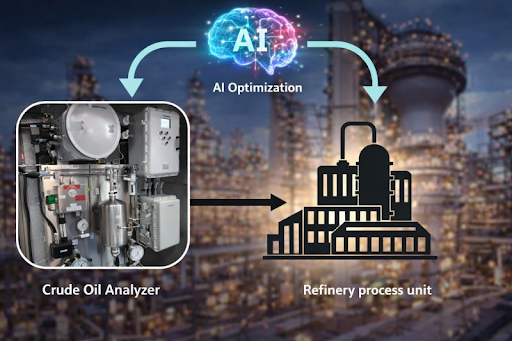
Near-Infrared (NIR) analysis uses light to “read” the molecular characteristics of crude oil as it flows through a pipe. Instead of taking samples to a lab, the analyser continuously measures how the crude interacts with specific wavelengths of light. From this, it can infer key quality indicators relevant to refining behaviour.
In practice, this means:
- continuous measurement, not snapshots,
- no delay between change and detection,
- suitability for online integration with control and optimisation systems.
For non-specialists, the simplest way to think about NIR is this:
it gives operators a live picture of how the crude is likely to behave in the unit — not just what it is called on paper.
Positioning online crude analysis as an optimisation tool
Within this context, the online crude NIR analyzer is increasingly used as part of refinery optimisation strategies rather than as a standalone measurement device.
Its value lies in enabling:
- continuous visibility of feedstock quality during blends and transitions,
- tighter CDU control under variable crude conditions,
- more reliable optimisation inputs for APC and planning systems.
Crucially, this approach aligns with how UK and European refiners are evolving: fewer assumptions, more measurement; fewer buffers, more control.Explainer box: What does “CDU optimisation” actually mean?
In simple terms, CDU optimisation is about running the crude unit closer to its true economic optimum, even when inputs change.
Instead of adjusting one variable at a time, optimisation platforms consider the CDU as a connected system — balancing:
- throughput,
- cut quality,
- energy consumption,
- downstream constraints,
- and product value.
The goal is not maximum severity, but maximum margin, achieved safely and repeatably.
From experience-based operation to data-anchored control
Historically, refinery excellence relied heavily on operator experience and conservative buffers. While expertise remains critical, today’s market conditions demand faster, more coordinated responses than manual intervention alone can deliver.
By embedding optimisation directly into CDU control strategy, refiners gain:
- earlier detection of destabilising trends,
- reduced reliance on safety margins as a substitute for certainty,
- and improved alignment between planning intent and operational reality.
This shift is particularly relevant in Europe, where flexibility and efficiency increasingly determine competitiveness.
The bigger picture: optimisation is becoming a survival skill
Recent oil market dynamics have shown that volatility no longer arrives in long, predictable cycles. It emerges suddenly, driven by geopolitics, logistics, policy shifts and demand uncertainty.
For UK and European refiners operating with high fixed costs and tight margins, the ability to adapt in real time is no longer optional. Advanced CDU optimisation — supported by continuous data, integrated models and automated decision support — is becoming a core capability.
Who is Modcon?
Modcon Systems Ltd. is an international technology company specialising in process analytics, advanced control and optimisation solutions for the energy and process industries. With decades of experience supporting refineries worldwide, Modcon focuses on integrating real-time measurement, control and optimisation to help operators improve efficiency, safety and economic performance under increasingly volatile market conditions.
Stay in touch to get more updates & news on Daily!