When considering facial rejuvenation, the goal for most patients is not to look different, but to appear like a refreshed, well-rested, more youthful version of themselves. The question then becomes: which facelift technique provides the most natural-looking results? For anyone exploring a facelift surgery in London, it is essential to understand the differences between the main modern approaches: the SMAS facelift (including extended SMAS variations) and the Deep Plane Facelift.
The term “traditional facelift” can be misleading, as it is often used to describe a wide range of SMAS-based techniques, some more advanced and effective than others. To make a truly informed decision, patients need to understand what a SMAS facelift does, what a Deep Plane Facelift does differently, and why those differences matter for naturalness and longevity.
Understanding the Role of the SMAS in Facelift Surgery
A key element in contemporary facelift surgery is the SMAS (Superficial Musculoaponeurotic System), a fibrous and muscular layer beneath the facial skin. As ageing progresses, both the skin and the SMAS descend, contributing to jowls, nasolabial folds, and loss of jawline definition. The best facelifts work not by simply pulling the skin tight, but by repositioning the SMAS, which creates a structural improvement rather than a purely surface-level change.
What Is a SMAS Plication Facelift?
In a SMAS Plication Facelift, sometimes referred to as a SMAS facelift, the skin is first elevated, and then the SMAS is folded and tightened with sutures. This can offer a visible improvement for patients with early to moderate signs of ageing and is a clear step up from skin-only facelifts. However, once the skin has been separated from the SMAS, the SMAS layer becomes thinner and mechanically weaker. This limits how much safe lifting force can be applied, especially in the mid-face, where a stronger, deeper elevation would be needed to restore youthful contours. Because the deeper retaining ligaments are not fully released, the SMAS Plication facelift has restricted capacity to correct heavier jowling or significant mid-face descent, and its longevity may be shorter than with deeper techniques.
Extended SMAS Facelift: How It Improves on Plication
A more extensive variant is the Extended SMAS Facelift, which involves dissecting and lifting a broader segment of the SMAS, extending more into the face and neck. This can provide a more powerful improvement in the lower face and neck and greater durability than simple plication. However, even in an Extended SMAS facelift, the skin and SMAS are still separated at the outset. This separation weakens the SMAS structurally and increases the risk of tearing when higher tension is applied. As a result, although the Extended SMAS facelift is effective for jawline and neck rejuvenation, it still does not fully address the mid-face or the descent of the cheek fat pads, as its lifting strength is ultimately constrained by the mechanically weakened SMAS.
What Makes the Deep Plane Facelift Different?
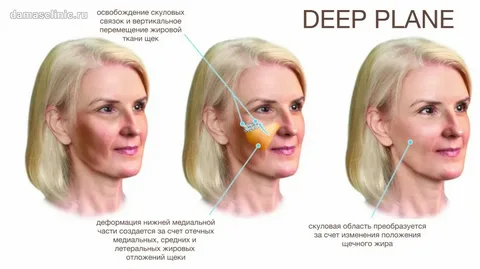
The Deep Plane Facelift represents a more advanced and anatomically respectful approach. For patients seeking the most natural results and researching the best deep plane facelift London has to offer, the key distinction is that the deep plane technique works beneath the SMAS, while keeping the skin and SMAS attached as a single composite unit. Instead of separating the skin from the SMAS, the surgeon releases the key retaining ligaments under the SMAS and mobilises the cheek, jowl, and lower face tissues together as one intact layer. Because the tissues retain their full thickness and mechanical strength, they can be repositioned safely and effectively back towards their original youthful position.
Why the Deep Plane Facelift Looks More Natural
This composite lifting is the fundamental reason the deep plane facelift delivers such natural results. The face is not simply tightened; it is structurally repositioned. By lifting the deeper structures directly, the skin can be redraped with minimal tension, avoiding the windswept or “pulled” appearance sometimes associated with more superficial SMAS techniques. A Deep Plane Facelift restores cheek contour, mid-face volume, jawline definition, and neck harmony in a way that looks balanced, expressive, and age-appropriate.
Surgeon Skill and Longevity of Results
The deep plane approach is more technically demanding and requires a surgeon with extensive experience and a detailed understanding of facial anatomy. However, when carried out by a skilled and experienced surgeon, the results can be exceptionally natural and long-lasting. Many patients who undergo a Deep Plane Facelift simply look refreshed and well-rested, rather than “operated on”, which aligns perfectly with the goal of modern facelift London patients: restoration rather than alteration.
SMAS vs Deep Plane Facelift: Which Should You Choose?
Choosing between a SMAS facelift and a Deep Plane Facelift depends on each patient’s anatomy, degree of ageing, and aesthetic goals. SMAS plication and Extended SMAS techniques still have a role, particularly for patients with earlier signs of ageing or primarily lower-face concerns. However, for those seeking the most natural, comprehensive, and enduring rejuvenation, the Deep Plane Facelift is often considered the superior option. By addressing the deeper structural causes of facial ageing rather than relying on skin tension, it has become widely regarded as the gold standard for patients looking for subtle, elegant, and long-lasting facelift results in London.