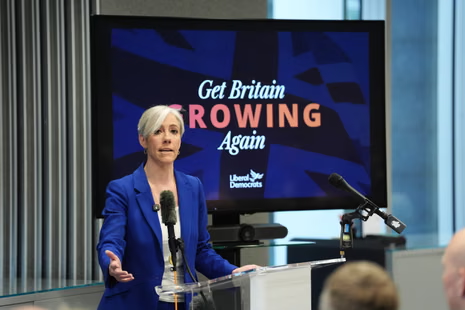
Wednesday, February 11, 2026 — London The Liberal Democrats have called for a sweeping restructuring of the UK Treasury, arguing that the department has become an “anti-growth” institution that is stifling economic expansion and regional development.
The proposal, unveiled ahead of Prime Minister’s Questions in the House of Commons on Wednesday, would see the Treasury split into two separate bodies — one focused strictly on fiscal discipline and public spending, and another dedicated to long-term economic growth and industrial strategy.
Lib Dem leader Sir Ed Davey said the current structure concentrates too much power in a single department that often prioritizes short-term budget control over sustained economic planning.
“For too long, the Treasury has acted as a brake rather than an engine,” Davey told reporters in Westminster. “We need a system that encourages investment, innovation and regional prosperity, not one that defaults to caution at every turn.”
The proposal comes amid ongoing debate about the UK’s sluggish productivity growth and uneven recovery across regions. Business groups have repeatedly warned that bureaucratic bottlenecks and centralised decision-making are slowing investment in infrastructure and green energy projects.
Under the Liberal Democrats’ plan, a newly created Department for Economic Growth would coordinate with local authorities, oversee industrial policy, and manage long-term investment strategies, while the Treasury would focus on fiscal oversight, taxation, and debt management.
Senior government officials dismissed the proposal as unnecessary and potentially destabilising.
A Treasury spokesperson said, “The UK’s fiscal credibility and economic management are strengthened by a unified approach. Splitting responsibilities risks confusion at a time when stability is essential.”
Economists remain divided on the issue. Some argue that separating fiscal oversight from growth strategy could allow for more targeted development planning. Others caution that institutional fragmentation may complicate coordination between spending decisions and economic policy.
The debate also reflects broader tensions within Parliament over how to stimulate growth while maintaining fiscal discipline. Rising public sector wage demands, infrastructure funding pressures, and defence spending commitments have tightened budgetary constraints.
Political analysts say the Lib Dem proposal is likely aimed at distinguishing the party’s economic message as attention shifts toward regional inequality and investment in emerging industries.
With inflation stabilising but growth forecasts modest, the government faces renewed pressure to demonstrate a clear economic roadmap.
The proposal is expected to be debated further in the Commons later this month.